RubusArcAssess
AI readiness assessments · for independent consultants

One consultant.A whole company, interviewed.Every stakeholder, in parallel.Discovery that scales itself.Findings backed by evidence.Answers in days, not weeks.

RubusArc Assess runs your discovery interviews for you, an AI interviewer under your brand that talks to every stakeholder in parallel and hands back quantified, evidence-linked findings. You keep the judgment, the relationship and the report.

Free to set up · your brand, your methodology
Acme AI AdvisoryAI readiness interview · Northwind Foods
Roughly how many minutes does one invoice take to enter, and how often each week?
About 30 minutes each, maybe 20 a week.
What each stakeholder talks to, under your brand
AI Readiness AssessmentFinal
Opportunity portfolio · Northwind Foods
OpportunityAnnual impact
Automate invoice capture1240 hrs · $12,000

[1]“We type every invoice in twice.” · Finance lead

20+
stakeholders interviewed in parallel
Days
from kickoff to cited findings, not weeks
100%
of findings linked to the transcript
Yours
brand, logo and methodology on every screen

See it in action

One assessment, three points of view

The same engagement as you run it, as your client’s team experiences it, and as it lands on the executive’s desk.

rubusarc.ai/tenants/northwind/assessments
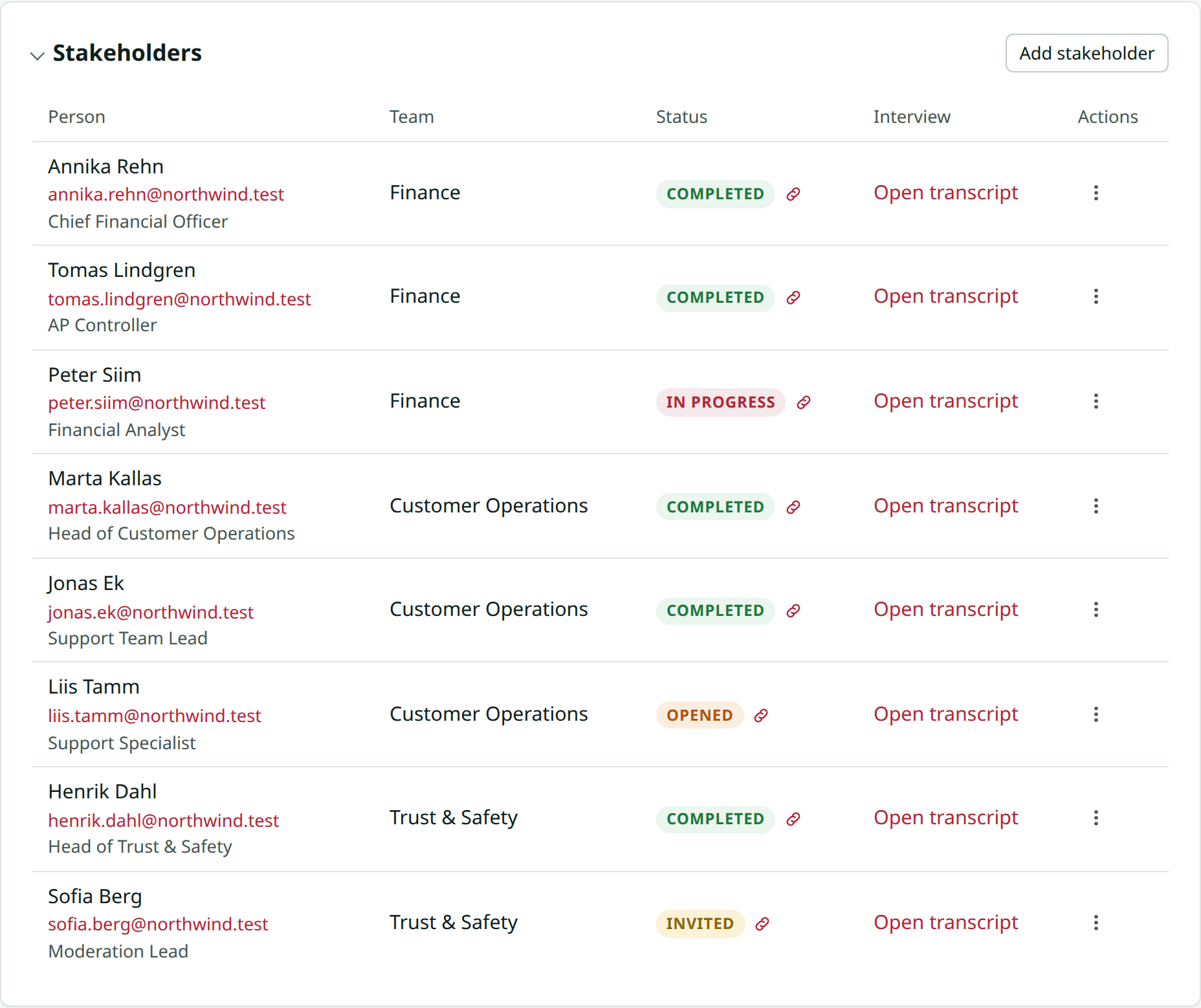
The stakeholders card of an engagement mid-round: eight people listed by team, five interviews completed, one in progress, one opened but not finished, and one still only invited — each row linking to its transcript.
Fig. 1the round, halfway throughDrag the picture to see the rest

You configure the engagement, then watch every interview land, who’s done, who to chase, what’s ready to report.

Captured from the product itself, running. Northwind Foods, the people in it and every figure they produced are a fixture we run the pipeline against — not a customer.

Not a questionnaire

It asks the second question.

A form collects what people already know how to say. The number you need is one nobody has written down — and it only arrives on the third or fourth follow-up.

One answer, as anyone would give it

“We key them in off the PDFs. It’s a bit of a nightmare, honestly.”

What it asked next

  1. How many come in over a week?about 20
  2. And how long does one take to key in?half an hour
  3. Who is doing that — one person, or a few?two, in finance
  4. What happens on the ones that go in wrong?a credit note, ~2 hours

What the report got

520 hours a year, keying in invoices

Quantified, and cited back to the sentence it started from — so the client can argue with the number instead of doubting it.

It can know what the round already found

Turn it on and the eleventh conversation starts where the tenth finished: the interviewer follows up on what a colleague has already described, within a team or across the whole engagement. Off by default, your choice per engagement — and a team of one or two is held back, because “someone in finance” is a name when finance is one person.

And it tells you what it actually covered

Every question area of yours comes back covered, still open, or “not my remit” with the person’s own reason. The interviewer says so itself rather than leaving you to infer coverage from what it happened to collect, so you know which gaps are real before you write.

The exchange above is drawn, not captured — same fixture as the screenshots, and the same four follow-ups the interviewer is built to ask.

What it costs to run

Done by hand, or with RubusArc.

One engagement, drawn against the same calendar both ways. Set it to the size of the client you are thinking of.

stakeholders
Week 11
Week 22
Week 33
Week 44
Week 55

Run by handBy hand

Two consultants, one interview at a time

5 weeks

Before the client has the reportTo the report

1522 days*

Senior time it consumesSenior time

Run on RubusArcOn RubusArc

Every stakeholder at once, on their own time

3 weeks

Before the client has the reportTo the report

23 days*

Senior time it consumesSenior time

Scope it, write the interview guide, chase 12 diaries (week 1 of the run-by-hand track, 5 weeks in total)
12 interviews, an hour each, three a week per consultant (week 2 to 3 of the run-by-hand track, 5 weeks in total)
Type the transcripts back up and reconcile what they said (week 4 of the run-by-hand track, 5 weeks in total)
Cost the opportunities by hand, then write the report (week 5 of the run-by-hand track, 5 weeks in total)
Configure the engagement and send 12 private links (week 1 of the run-on-RubusArc track, 3 weeks in total)
All 12 answer in parallel, on their own time (week 2 of the run-on-RubusArc track, 3 weeks in total)
Cited findings arrive; you curate them and decide what ships (week 3 of the run-on-RubusArc track, 3 weeks in total)
Hatched — senior time being consumedSolid — work RubusArc is doing

Same 12 conversations, and the same person deciding what they mean. The client has the report 2 weeks sooner, and the senior time it costs you falls from 1522 days to 23.

* A model of a typical engagement, not a quoted price or a measured result. By hand assumes two consultants holding three interviews a week each, an hour per interview plus preparation and write-up, then synthesis and writing. On RubusArc assumes the interviews run in parallel inside one week and that you read every transcript back. Both day figures are shown as a band 20% either side of the model. Engagements vary.

How it works

From setup to decisions, in four steps

You configure once; stakeholders interview on their own time; the evidence rolls up to you; and what the client agrees to stays on the record.

1

Configure the engagement

Set the client context, question areas and teams, add your brand, the interview agent drafts from your own methodology.

2

Stakeholders interview via a link

Each stakeholder gets a private link and talks to the agent for 20–30 minutes, no scheduling, no accounts, pause anytime.

3

Curate the findings, ship the report

Every opportunity, inefficiency and risk comes quantified and cited. You decide what makes the deliverable, then hand it over.

4

Take the decisions, then come back

The client accepts, declines or defers each opportunity, with an owner and a date. Re-assess next round to measure what moved.

Built for independent consultants

Discovery that scales past your calendar

Spend your senior hours on judgment and the report, not on scheduling, note-taking and chasing.

01

Your brand, front and centre

Stakeholders see your name, logo and colours. The practice is yours; RubusArc stays invisible.

02

A whole company, in parallel

Twenty stakeholders in the time one workshop takes, each on a private link on their own day, no calendars to wrangle.

03

Findings that stand on evidence

Every opportunity is quantified, time, frequency, cost, and cites the exact words in the transcript.

04

You keep the judgment

Review every transcript, curate the findings, and decide what makes it into the report.

05

Decisions, not just findings

Each opportunity is accepted, declined or deferred with an owner, a date and who agreed it, in the client’s own hand or recorded by you.

06

A second round is a second engagement

Re-assess the same client later and the interviewer is briefed on what was agreed, so the follow-up costs you less than the first round did.

Questions

The things consultants ask first

Do stakeholders need to sign up for anything?

No. Each person gets a private link and starts talking, no accounts, no scheduling, and they can pause and resume anytime.

Whose brand do they see?

Yours. Your name, logo and colours brand every interview and the final report. RubusArc stays behind the scenes.

How does it know what to ask?

You bring your methodology and question areas; the interviewer drafts from them and probes for the specifics, systems, volumes, hours, cost.

How long is an interview?

Twenty to thirty minutes per stakeholder, on their own time. You can run the whole company at once.

Do I stay in control of the report?

Always. You review every transcript, curate the findings, and decide what makes it into the deliverable.

What do I hand my client?

A quantified report where every figure links back to the transcript that supports it.

How is this different from sending a questionnaire?

A form takes the first answer. The interviewer takes the fourth: it hears “it’s a nightmare” and asks how many, how long, who and what it costs when it goes wrong.

What happens after the report?

The plan is a working surface. You and the client accept, decline or defer each opportunity, with an owner and a date, and RubusArc records whether they said it themselves or you recorded it for them.

Run your next assessment with RubusArc Assess

Set up your first engagement and send interview links today, free to start.